New customer?
Start Here.Featured Brands
Recommended Products
INSIDER
Get free shipping, on most items, with your $50 purchase today! Same day shipping on most orders if placed by 3pm PST.
PLEASE NOTE:
This offer is only available to physical shipping addresses in the 48 continental United States (no PO Boxes), and some exclusions apply.
Oversize Charges
Some large and/or heavy items are subject to additional oversize charges that are separate from standard shipping costs.
Bike Build Process
All bikes are built, tested, tuned, and ready to ride upon shipment. The bike build process typically takes 2-3 days to complete depending on the bike model and the complexity of the build.
Stock Status
Orders for in-stock items placed by 3PM PST usually ship on the same day. Orders that include special-order or backordered items may be subject to shipping delays depending on product availability. Refer to estimated delivery times in cart when selecting shipping options.
Featured Brands
Recommended Products
Need Gear Advice?
Our Gear Advisors are Ready to Help.
What R-value actually measures, how foam, air, and self-inflating pads compare in real-world use, and which to pick for backpacking, car camping, or winter cold.
R-value measures a pad's resistance to heat loss into the ground. It's the single most important spec on a sleeping pad — even an expensive bag can't keep you warm if the cold ground is pulling heat out from underneath. As of 2020, the ASTM F3340 standard governs how R-values are tested, so numbers across brands are directly comparable.
A practical rule: pair pad R-value to expected ground temperature, not air temperature. A 35°F night with frozen ground is colder underneath than a 35°F night with warm soil holding the day's heat. When in doubt, err warmer — R-values stack, so a high-R pad in summer just vents through the bag.

The trade-off that drives pad selection. Lightweight wins for backpacking, bikepacking, and weight-critical trips. Durable wins for car camping, overlanding, and anywhere you'll sleep on rough ground for nights at a stretch.
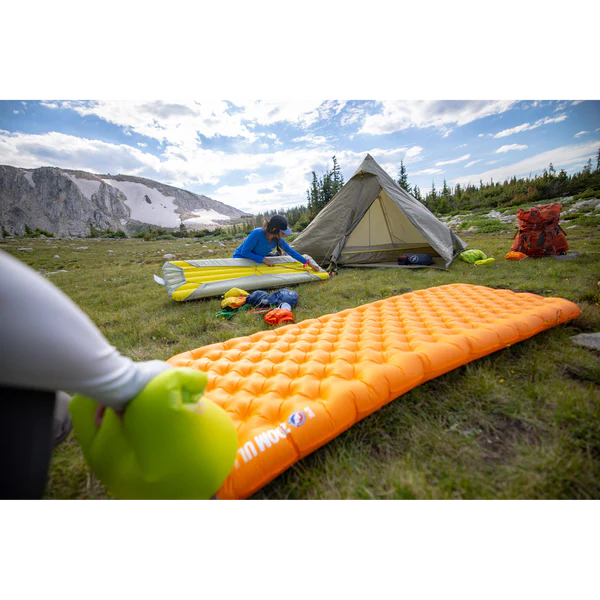
Best for: Backpacking, bikepacking, fastpacking, ultralight setups. The Nemo Switchback (closed-cell foam) and Big Agnes Zoom UL Insulated (air-insulated) are good representatives of this lane.
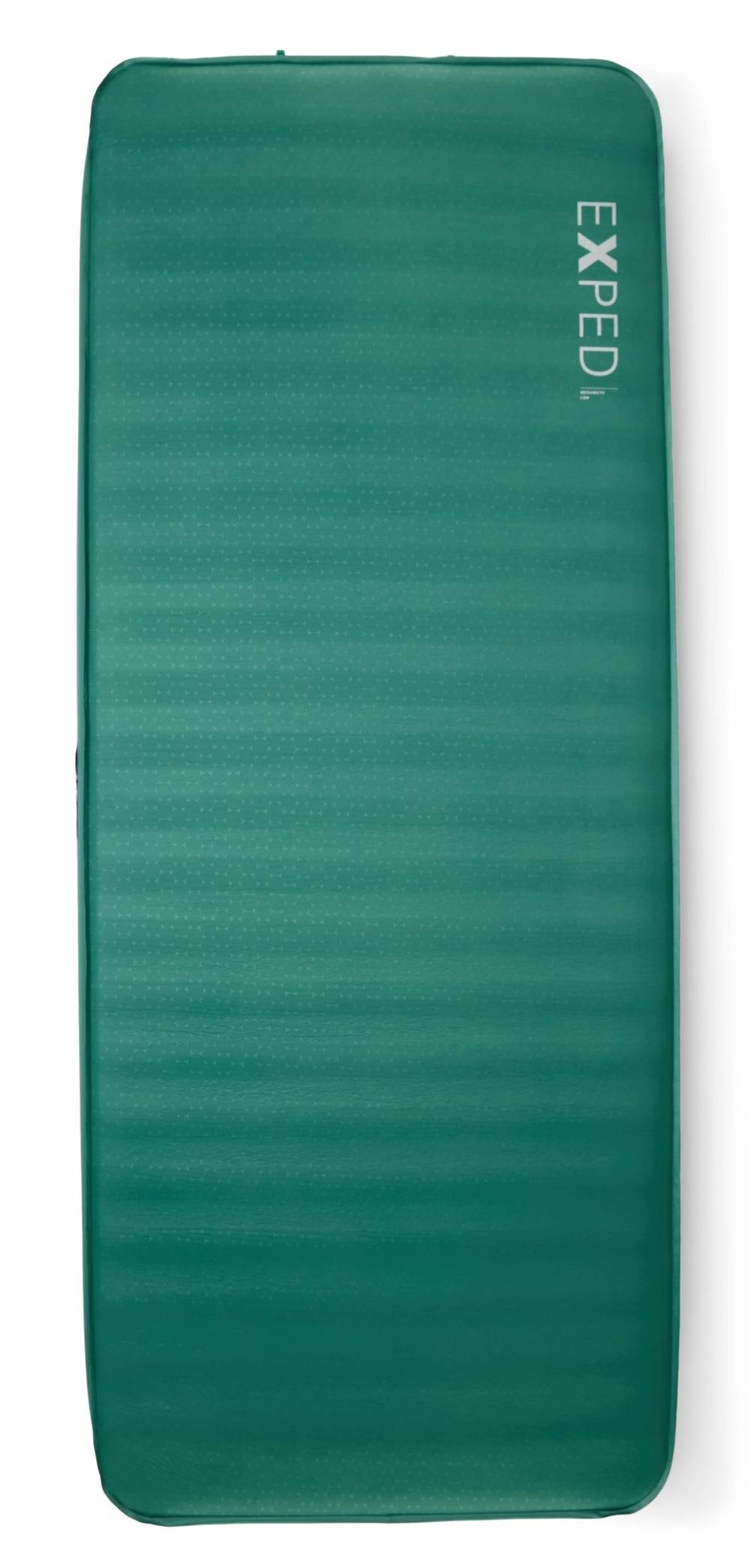
Best for: Car camping, base camping, overlanding, winter trips, anyone who values comfort over pack size. The Rab Exosphere 3.5 (self-inflating) and Exped MegaMat are good examples here.
Every sleeping pad belongs to one of four construction families. Each makes a different trade-off between weight, comfort, durability, and warmth.
All four also work as stackable insulation. A closed-cell foam pad under an inflatable adds R-value and protects the inflatable from rocks and roots. This is standard winter setup.
Side by side at a glance. Specs reflect the four pads shown in the video above.
|
Closed-Cell Foam
Nemo Switchback |
Air Insulated
Big Agnes Zoom UL |
Self-Inflating
Rab Exosphere 3.5 |
Air + Foam Hybrid
Exped MegaMat |
|
|---|---|---|---|---|
| Weight | 14.5 oz lightest option |
~14 oz comparable to foam |
23.4 oz heavier than air pads |
4+ lbs car camp only |
| Packed Size | Folds flat, straps to outside |
Smallest — fits inside pack |
Rolls down, stuff sack included |
Large roll, car camp only |
| R-Value | R 2.0 summer & supplement |
R 4.3 3-season capable |
R 3.4 3-season capable |
R 6.8 winter-ready |
| Thickness | ~0.75 in firm, minimal cushion |
~3.5 in full cushion when inflated |
~1.5 in foam-backed comfort |
4 in mattress-grade |
| Puncture Risk | None indestructible |
Moderate carry patch kit |
Low foam holds shape |
| Best For | Ultralight backpacking, supplemental layer under air pad | Backpacking, bikepacking, fastpacking | 3-season camping, reliability over weight savings | Car camping, overlanding, winter base camps |
One pad from each construction family — closed-cell foam, air-insulated, self-inflating, and air-foam hybrid. Pick by how you camp, not what's on sale.


Tap any card for current pricing, stock, and full specs. Spec values reflect the regular size; longer/wider versions add weight.
Find your scenario and we'll point you to the pick that fits.
Lung inflation works in a pinch, but the moisture in your breath ends up inside the pad — over time that water vapor degrades the internal lamination and grows mildew. Use the included pump sack whenever possible. It's faster, drier, and extends the pad's life. Self-inflating pads do most of the work themselves; just top off with a few breaths or pumps once the foam has expanded.
Sticks, pinecones, and sharp pebbles are how inflatable pads die. Sweep the tent footprint before pitching. If the ground is rough, put a closed-cell foam pad or a piece of Tyvek under the inflatable to absorb abuse — the stack adds R-value on top of protecting the pad.
Long-term compression flattens the open-cell foam inside self-inflating pads, which kills their ability to self-inflate. Store them flat under a bed or rolled loosely with the valve open, not crammed into the stuff sack. Air-insulated pads are more forgiving and pack down fine between trips.
Most pads ship with a patch kit; keep it with the pad, not in a junk drawer at home. If you can't find the hole, submerge the inflated pad section by section in a creek or tub and watch for bubbles. Mark, dry, and patch per the kit's directions. Tenacious Tape works as a field backup.
Three small purchases that punch above their weight.
Most modern pads include one, but if yours doesn't, a dedicated pump sack inflates a pad in 2–3 swings and keeps lung moisture out of the chambers.
Shop Pump Sacks ›A 2–4 oz inflatable pillow keeps your spine aligned with the pad's surface and dramatically improves side-sleeper comfort.
Shop Camp Pillows ›Self-adhesive patches and a small tube of glue. Carry them with the pad, not in your garage — a leak you find at mile 14 isn't useful to fix at home.
Shop Repair Gear ›Quick reference for the specs and terms you'll see on tags, brand pages, and product listings.
Miranda helps customers dial in their sleeping setup for everything from backyard campouts to multi-day backcountry trips. She's the on-camera guide in the video at the top of this page, and her recommendations here are based on years of sleeping outside in conditions ranging from the desert to the alpine.
Ready to gear up? Browse the full selection across brands, R-values, and pad types.
Follow Jensonusa